Carbon fibre is neither a metal nor a plastic. It is a fabric woven from carbon filaments, soaked in resin and cured in the shape it needs to hold. Everything else follows from that: the familiar herringbone-style weave, a weight around half that of steel, and a price that can make a carbon bonnet cost as much as a used car.
Let’s take it step by step: what it is made of, why it looks the way it does, how forged carbon differs from regular carbon fibre, and how to tell a genuine part from carbon-look wrap film.
What is carbon fibre, in plain terms
Carbon fibre is a composite: two different materials that perform poorly on their own but together deliver something neither of them has.
- Carbon fibre filaments – threads around 7 microns thick, ten times thinner than a human hair. They carry tensile loads and barely stretch.
- Resin (usually epoxy) – binds the filaments together, holds the shape and transfers load from one filament to the next.
Fibre without resin is just cloth; you can crumple it in your hand. Resin without fibre is brittle glass. Together they create a material that weighs less than aluminium yet carries load better than steel.
The correct technical name is carbon fibre reinforced polymer, or CFRP. “Carbon” on its own is simply the shorthand for carbon fibre that has stuck in the car world.
Is carbon fibre a metal?
No. It is a common misconception, and an understandable one: carbon looks high-tech, rings when you tap it and costs a lot – all things we associate with metal.
But there is no metal in it at all. Carbon fibre is almost pure carbon – the same chemical element found in pencil graphite and in diamond. The only difference is how the atoms are arranged.
That leads to practical consequences that set carbon apart from steel and aluminium:
- it does not rust – there is nothing in it to corrode;
- it does not dent: metal takes a dent on impact and stays in one piece, while carbon holds up to a certain limit and then cracks or delaminates;
- it does not conduct heat the way metal does and barely expands when heated;
- it is not magnetic – a magnet will not stick to a genuine carbon part.
What carbon fibre is made of and how it is produced
Where the fibre itself comes from
The raw material for most carbon fibres is polyacrylonitrile, a synthetic polymer. It is drawn into threads, which are then heated with almost no oxygen present to temperatures of around 1000–1500 °C. Everything else burns off, leaving practically pure carbon aligned along the thread. That alignment is exactly what gives the fibre its strength.
The finished filaments are gathered into tows. That is where the markings you will see in part descriptions come from:
| Designation | Filaments per tow | Where you usually find it |
|---|---|---|
| 1K | 1,000 | thin parts, fine pattern |
| 3K | 3,000 | the most common in car tuning |
| 6K | 6,000 | large, bold pattern, body panels |
| 12K | 12,000 | large structural parts, industry |
The higher the number, the thicker the tow and the larger the visible weave pattern. This is not about “better” or “worse” – it is about appearance and how the fabric drapes over a complex shape. On large panels such as a bonnet, the bold 6K pattern looks in proportion; on a small part, the same pattern would look coarse.
How fabric becomes a part
The industrial method used for premium-grade body parts is prepreg with an autoclave:
- The fabric is pre-impregnated with resin under factory conditions and stored cold – that is what prepreg means. The resin-to-fibre ratio is controlled precisely rather than judged by eye.
- The fabric is laid into the mould in layers, each one turned to its own angle, so the part carries load in every direction rather than only along the threads.
- The mould is sealed in a vacuum bag and goes into an autoclave – a pressurised oven where the part is heated and compressed at the same time.
The pressure squeezes out air and excess resin. That is what separates a factory part from a cottage-industry one: cheap “wet” lay-up leaves air bubbles inside and more resin than it should, so the part ends up heavier and weaker while looking the same.
The number of layers and their orientation is an engineering task in its own right. Two parts with an identical pattern on the outside can be a light, strong panel or a heavy, brittle copy – the difference is inside, where you cannot see it.
What carbon fibre looks like
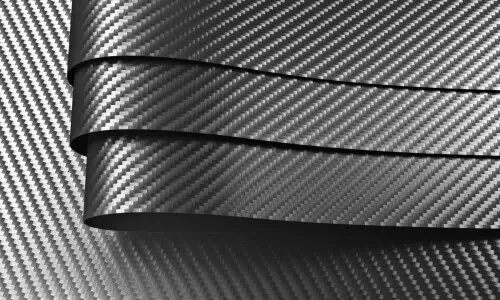
Carbon gets its recognisable look from the weave – the way the threads are interlaced.
- 2×2 twill – the classic diagonal, herringbone-like chequered pattern. The most popular choice in car tuning: it drapes well over curved surfaces and gives a deep, three-dimensional pattern.
- Plain weave – a simple checkerboard. It looks more restrained and calmer, but it stretches less well over complex shapes.
- Unidirectional (UD) – the threads all run one way, so there is no real pattern. It is used where strength in a specific direction matters more than looks.
On top of the weave comes the clear coat, and it defines the character of the part: gloss gives mirror-like depth and brings out the pattern, while a matte finish makes the part more understated and closer to an OEM look. On dark cars, carbon often only shows in sunlight – and that is frequently exactly the effect owners want.
Real carbon fibre is always black with a graphite sheen: there is no point painting it, as that would lose everything it was chosen for. Coloured “carbon” is glass fibre or Kevlar with coloured thread woven in.
Forged carbon vs carbon fibre: what is the difference
Forged carbon is the same carbon and the same resin, but without the fabric. Instead of a woven sheet, chopped fibre – short strands – is mixed with resin and pressed in a mould under pressure.
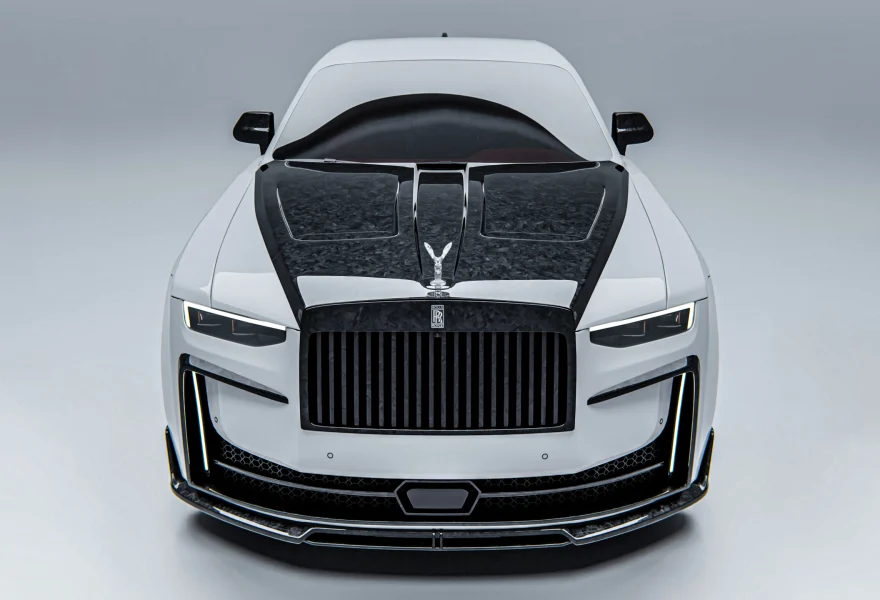
It has no weave pattern. Instead it has a random pattern that looks like black marble or a cut stone surface. Every part is unique: two identical patterns are physically impossible.
What makes it interesting in practice:
- complex shapes are easier – chopped fibre fills geometry where woven fabric would crease;
- the look has a different character – less technical, more like jewellery;
- strength is more even across directions, but peak strength along the fibre is lower than that of woven carbon with a correct lay-up.
Choosing between forged and woven carbon is more often a question of style than of engineering. Forged carbon suits accent parts and interiors; woven carbon suits large body panels.
Real vs fake carbon: how to tell carbon fibre from wrap film
Carbon-look wrap film and hydro dipping cost a fraction of the real thing and look similar from a distance. You can tell them apart without any tools.
- Look at the edge of the part. Real carbon shows the fabric layers in cross-section. With film, you see a plastic edge covered from above, and the film itself is folded over or trimmed at the edge.
- Follow the pattern over a curve. Film stretches over bulges, and the checks become elongated. With laid-up fabric the pattern changes differently, and on complex shapes you can see where fabric sheets meet – that is normal and actually indicates genuine fabric.
- Lift the part. A carbon bonnet is noticeably lighter than the standard one – one person can lift it without effort.
- Tap it. Carbon gives a dry, ringing sound; plastic sounds dull.
- Try a magnet. It will not stick to carbon – but it will not stick to plastic under film either, so this only distinguishes carbon from metal.
- Check the price. A carbon bonnet cannot cost the same as a set of floor mats. If the price looks too good to be true, it is film.
One thing is worth saying separately: film is not a deception in itself. It is a legitimate way to change how a car looks for reasonable money. The problem only arises when film is sold as carbon.
What carbon fibre is used for on a car
- Bonnet – the most common carbon part. It is large, heavy in stock form and sits high above the front axle, so the weight saving is most noticeable here.
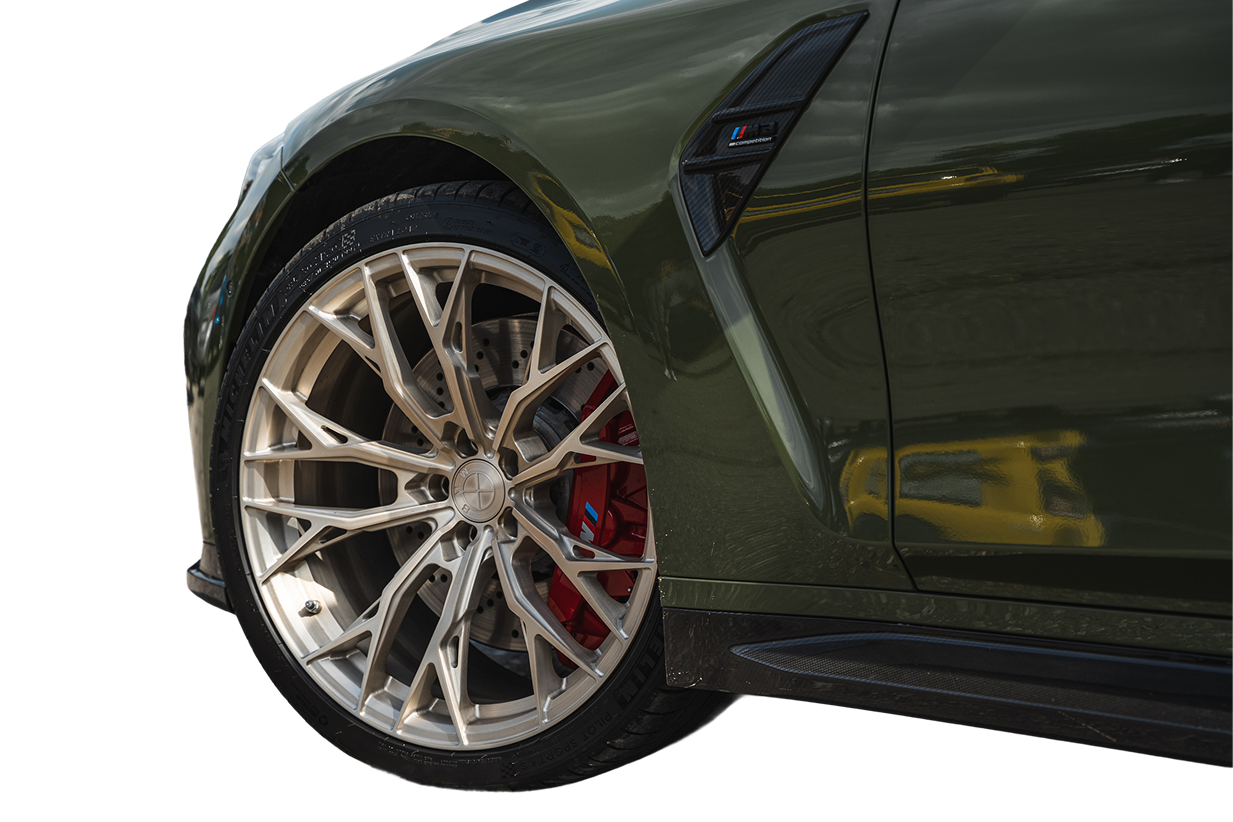
- Body kit elements – splitter, side skirts, diffuser, wheel arch extensions. Here carbon works for both looks and stiffness.
- Spoiler and wing – parts where stiffness at minimum weight matters.
- Mirror caps, grilles, trim pieces – accent parts that change the car’s look without touching the bodywork.
- Interior – console trim, door inserts, steering wheel.
- Roof – a rare choice and the most sensible one from an engineering point of view: it removes weight at the highest point of the car and lowers the centre of gravity.
For more on how these elements work together and what a carbon body kit delivers in practice, see the article Carbon fibre body kits: advantages, limitations and real-world use cases. To see what a car finished in carbon from end to end looks like, take the BMW X5M F95 in Black Sapphire with a full 6K carbon package.
How much carbon fibre weighs and what that gives you
The density of finished CFRP is roughly 1.5–1.6 g/cm³. For comparison: aluminium is 2.7, steel around 7.8. At equal stiffness, a carbon part comes out roughly half the weight of a steel one.
In practice, this is what it means. Replacing a standard bonnet with a carbon one takes around ten kilograms off the front axle. You will not feel that under acceleration – ten kilograms on a 1.5-tonne car does not change performance. But weight removed high up and far ahead of the axle has a more noticeable effect on steering response in corners than the same kilograms somewhere in the boot.
The honest conclusion: on a road car, carbon is chosen first and foremost for its looks and for the stiffness of the parts, and the weight saving is a welcome side effect rather than the main argument. Promises of “a second off your 0–100 km/h time from a carbon bonnet” have nothing to do with reality.
What to know in advance
- UV exposure. Epoxy resin yellows and turns cloudy in the sun over time. A clear coat with a UV filter protects it, and in hot climates a ceramic coating or polyurethane film on top.
- Repairs. Carbon can be repaired, but it is not a job for a regular body shop: it needs materials, tooling and experience. A deep crack often means replacing the part.
- Price. It is driven not by the cost of the fabric but by tooling, hand lay-up and the autoclave cycle. That is why a carbon part for a rare model costs more than the same part for a mass-market one – the mould pays for itself through volume.
In short: questions and answers
What kind of material is carbon fibre?
A composite of carbon fibre and resin. The fibre carries the load, the resin holds the shape. The correct name is carbon fibre reinforced polymer (CFRP).
What is carbon fibre made from?
From polyacrylonitrile threads: they are heated with almost no oxygen to 1000–1500 °C until pure carbon remains. The threads are gathered into tows, woven into fabric, impregnated with resin and cured in a mould.
What does carbon fibre look like?
A black surface with a graphite sheen and a three-dimensional weave pattern – most often a diagonal herringbone-style twill. Forged carbon has no weave; instead it has a pattern that resembles black marble.
What is the difference between 3K and 6K?
The number of filaments per tow: 3,000 versus 6,000. It makes almost no difference to strength but a big difference to looks: 6K has a larger pattern.
Why is carbon fibre used on cars?
For three things: looks, part stiffness at low weight, and the ability to produce complex shapes that in metal would need separate stamping tooling. On a road car, the first usually matters more than the other two.
Is carbon fibre stronger than steel?
In tension, yes – at half the weight. But it behaves differently: steel dents, while carbon holds up to its limit and then cracks.
Does carbon fibre rust?
No. There is nothing in it that can rust. Over time the clear coat may go cloudy from the sun – that is fixed with polishing and a protective coating.
Can you tell real carbon from film by eye?
Yes. Look at the edge of the part: real carbon shows the fabric layers in cross-section. And lift the part – carbon is noticeably lighter.
We will make a part for your car
RNG Design manufactures carbon fibre body kits across the full cycle – from development to series production, with in-house manufacturing and certification to TÜV standards. Browse body kits by model or get a quote for your car.