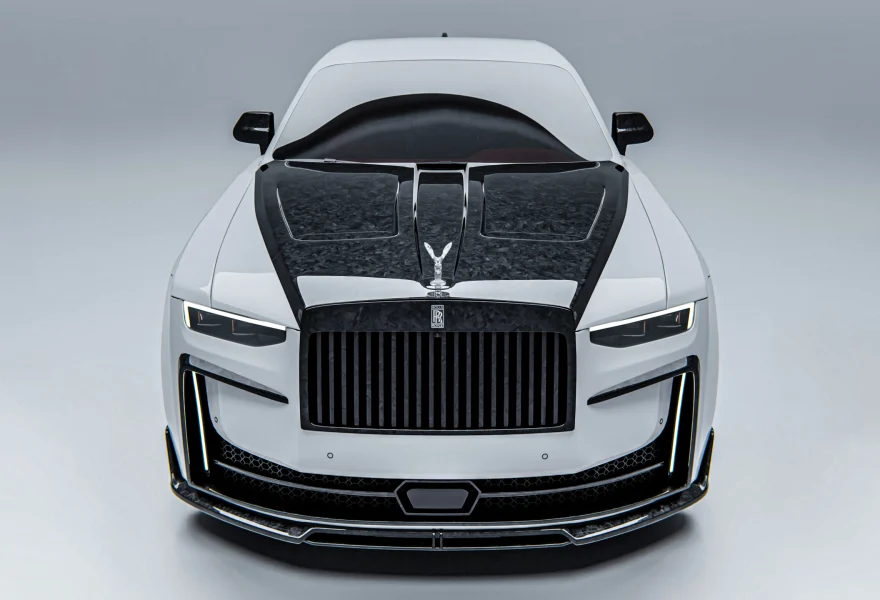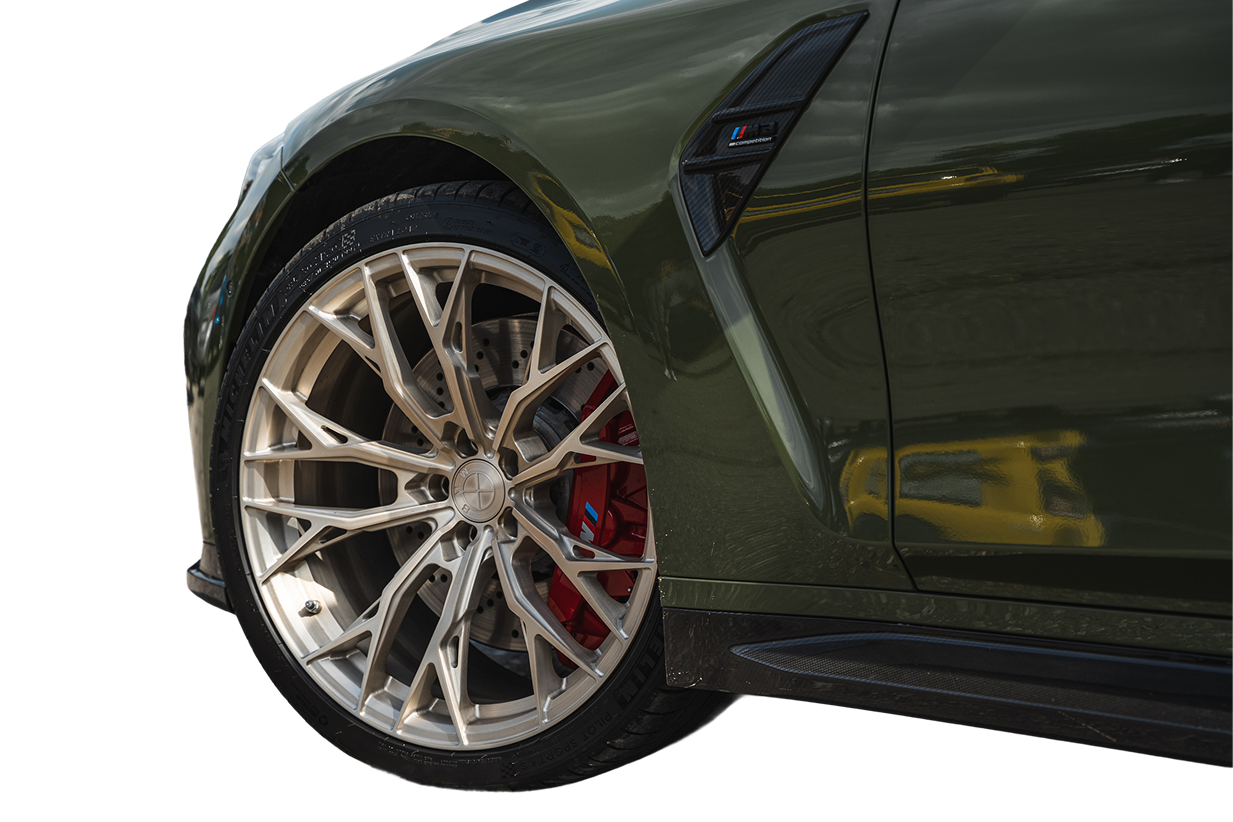

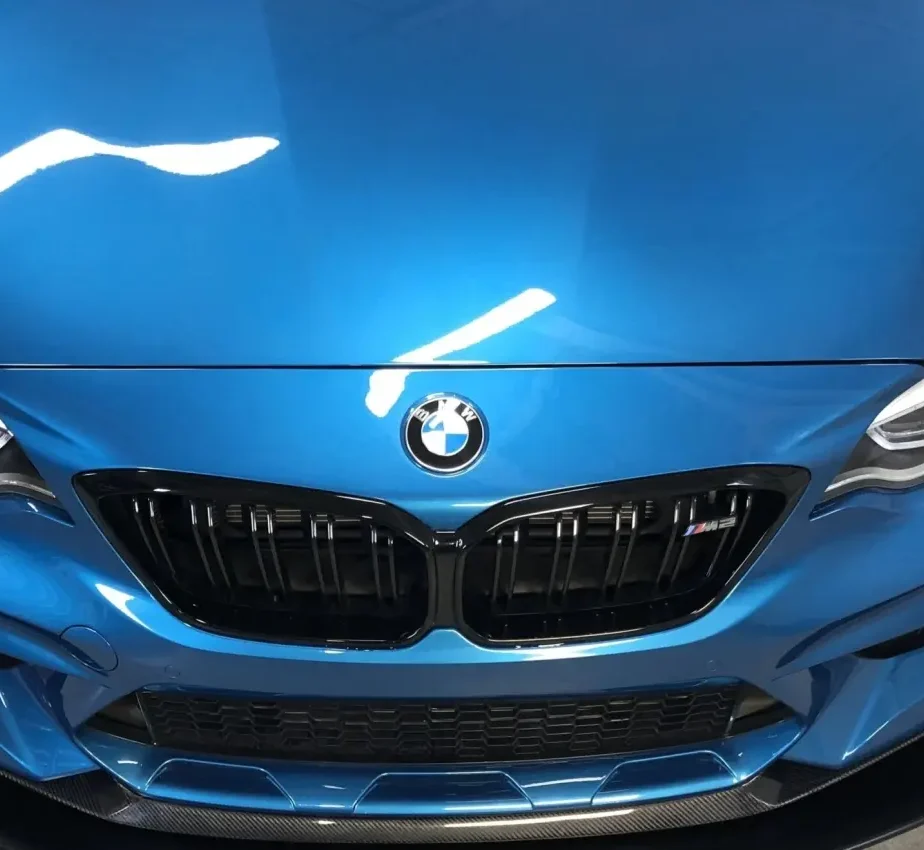
A front splitter is a horizontal plate at the bottom of the front bumper that sticks out forwards. The name says what it does: the plate splits the oncoming airflow in two — one part goes over it, the other goes under the car.
In shops and forums the same part is often sold as a front lip, lip spoiler or chin spoiler. Below we look at how a splitter differs from a lip and from canards, how it actually works, how it is mounted to the bumper and what you can expect from it on an everyday road car rather than on a race track.
What is a front splitter, in simple terms
Picture a flat plate fixed along the lower edge of the front bumper and protruding forwards by a few centimetres. That is a splitter.
When the car is moving, air runs into the nose. The plate splits the flow:
- Above the plate the air runs into the bumper and slows down. Where the flow slows, pressure rises — and that pressure pushes down on the plate from above.
- Below the plate the flow is squeezed into the narrow gap between the splitter and the road and speeds up. Fast-moving air means low pressure, in other words suction from below.
The pressure difference above and below presses the front axle onto the road. This force is called downforce.
The lower the splitter sits and the further it protrudes, the stronger the effect. That is why splitters on race cars almost touch the tarmac, while on road cars they are a compromise between aerodynamics and being able to get over a kerb.
Splitter, lip, canards, diffuser — what is the difference
The terms get mixed up all the time, and shops call the same part by different names. Let’s take them one by one.
| Part | Where it sits | What it does |
|---|---|---|
| Lip (front lip, lip spoiler) | lower edge of the front bumper | follows the bumper contour and adds a few centimetres downwards; mostly about looks |
| Splitter | lower section of the front bumper | a flat plate protruding forwards; works to create downforce |
| Canards | side corners of the front bumper | small fins that swirl the airflow along the sides of the car and steer it away from the wheel arches |
| Diffuser | under the rear bumper | an expanding channel that releases the fast-moving air from under the car and adds downforce at the rear |
In practice, splitter vs lip comes down to one thing: a lip goes down, a splitter goes forwards. A lip makes the front end look lower; a splitter creates a horizontal surface that the air can push on.
In everyday use the line is blurred: a part with a small forward overhang will be called both a lip and a splitter, and both are right. If you are looking for a part for your car, go by the photo rather than the name — can you see a horizontal surface, and how far does it stick out?
A practical tip: if you were searching for something like a “BMW front lip” or a “Mercedes front lip spoiler”, look in the splitters section — lips and splitters are listed there together, because they do the same job and are mounted the same way.
What does a front splitter do
Why fit one at all? A splitter has three jobs, and on a road car they rank in exactly this order.
1. Looks
Honestly and without illusions: on most cars a splitter is fitted for the look. It visually lowers the front end, adds width and makes the silhouette tighter. The car stops looking “tall” — this works especially well on crossovers and large SUVs, where the factory bumper is deliberately kept high for approach angle and ground clearance.
2. Downforce
It is real, but it does not appear straight away. Aerodynamic force grows roughly with the square of speed: double the speed and the effect quadruples.
What that means in practice:
- in town at 60 km/h the downforce from a splitter is close to zero;
- on the motorway at 120–140 km/h it is already noticeable — the car holds a straight line a little more confidently and reacts less to crosswinds;
- a clearly noticeable difference in handling only starts at speeds you cannot legally drive on public roads.
So promises like “a splitter will improve handling” are true as far as physics goes, not as far as your daily commute goes.
3. Protecting the bumper from below
A side benefit, but a useful one. The splitter takes contact with kerbs and deep snow before the factory bumper does. Replacing a splitter costs less than repainting or replacing the whole bumper.
A caveat: this holds for tough plastic splitters. A carbon fibre splitter is more likely to crack than to absorb a kerb strike — and replacing it will not be cheap.
Is a front splitter a good idea or not
It is a common question, and the honest answer depends on how you drive.
Probably a good idea if:
- you want to change how your car looks and you like the result;
- you can park without tall kerbs;
- you choose a part designed for your model rather than a universal strip.
Probably a bad idea if:
- you regularly drive over kerbs, through deep snow or on unmade roads;
- you have a steep ramp out of an underground car park;
- you expect a gain in performance — there won’t be one.
The main practical risk is not aerodynamics but geometry. A splitter lowers the front-most point of the car by 3–8 cm. Anything you used to clear with little room to spare will now have to be avoided or taken at an angle.
What splitters are made of
- ABS plastic — the most practical option for a daily driver. It flexes, survives kerb strikes, is cheap to repair and can be painted in the body colour.
- Fibreglass — stiffer and cheaper in small production runs, but more brittle: it chips on impact.
- Carbon fibre — the lightest and the most striking: the weave needs no paint and works as a design feature on its own. It costs more than the rest and is harder to repair. More about the material in our article What is carbon fibre.
- Aluminium — found on track cars: it bends instead of cracking, but looks utilitarian.
For a road car the choice usually comes down to plastic or carbon: the first for peace of mind, the second for looks and weight.
How a splitter is mounted to the bumper
The mounting method matters more than it seems: it is where corners are most often cut, and it is why splitters come off at speed.
1. Factory bumper mounting points. The right method for a part designed for a specific model. The splitter follows the bumper’s geometry and is pulled onto it with self-tapping screws or bolts through existing edges and ribs. No drilling into structural parts is needed.
2. Double-sided tape. Automotive acrylic tape (for example 3M VHB) holds reliably, but only for light add-on pieces with a small overhang, and only on a properly prepared surface: degreasing, primer, and a temperature of at least +15 °C during fitting. As the only fixing for a protruding splitter it is a bad idea.
3. Brackets to the bumper reinforcement bar or subframe. Needed when the plate protrudes noticeably. At speed the load acts on the leading edge with a long lever arm, and the bumper alone cannot hold it — it is not designed for that.
4. Support rods. Thin rods running from the front edge of the splitter up to the bumper. A solution borrowed from race cars: they take the bending load off the plate. On road cars they are rarely fitted — mostly for the look.
Three things decide whether a splitter will survive the winter:
- the gap is even along the whole length — if the part is forced into place and bent somewhere, that is where it will crack first;
- fixings do not go through a single layer of plastic — a screw needs either a factory edge or a washer on the back;
- there is allowance for temperature — plastic and carbon expand differently, and rigid fixing in frost works against the part.
If the splitter is made for your model, fitting takes a couple of hours in a workshop and needs no modifications. A universal “fits any car” strip will have to be adapted on the spot, and the result depends on the fitter’s skill.
Splitters with adjustable angle of attack
A separate type that people rarely ask about, but for good reason. The angle of the plate relative to the airflow can be adjusted — more angle means more downforce and more drag.
It makes sense where a car runs on different circuits: on a high-speed layout the angle is reduced for maximum top speed, on a twisty one it is increased for grip in corners. For a road car this is overkill: the difference only shows at speeds you cannot reach on public roads.
What to check before you buy
- Real ground clearance, not the spec sheet figure. Measure the distance from the lower edge of the bumper to the ground and subtract the splitter’s overhang.
- Fit for your exact model and facelift. Pre-facelift and facelift bumpers differ, and a part “for the same car” may not fit.
- Compatibility with parking sensors and the camera. A protruding plate can get into the sensors’ field and trigger false alarms.
- Car washes. Warn the staff: driving onto a lift and the high threshold of a car wash are typical places where splitters break.
- What’s in the box. A good kit comes with fixings and a template. If the fixings are “choose your own”, that is a question for the seller.
In short: questions and answers
What is a splitter on a car?
A horizontal plate at the bottom of the front bumper that protrudes forwards. It splits the oncoming airflow and creates downforce on the front axle.
What does a front splitter do?
It is there for looks, for downforce at high speed and to protect the bumper from below. On a road car the first usually outweighs the rest.
What is the difference between a lip and a splitter?
A lip runs down along the bumper contour, a splitter sticks out forwards as a horizontal surface. In everyday use both words are used as synonyms.
What are canards on a bumper?
Small side fins on the corners of the front bumper. They swirl the airflow along the sides of the car and steer it away from the wheel arches. They are not a splitter but a separate component.
How do you mount a splitter to the bumper?
Ideally through the factory bumper edges with bolts or self-tapping screws, and, if the overhang is significant, additionally on brackets to the reinforcement bar. Only light add-on pieces can be fitted with double-sided tape alone.
Does a splitter improve acceleration?
No. It adds downforce and, with it, a little aerodynamic drag. If anything, its effect on acceleration is negative, although small.
At what speed does a splitter start to work?
Noticeably from about 120 km/h. In town the effect is close to zero, because aerodynamic force grows with the square of speed.
Can you fit a splitter to a crossover?
Yes, and on large SUVs it has the strongest visual effect. But that is also where geometry matters most: check the ramps out of car parks and the kerbs you drive over.
We’ll find the right splitter for your car
RNG Design makes splitters for specific models — in carbon fibre and plastic, with fixings included. BMW and Mercedes-Benz are covered most thoroughly: front bumper lips for the BMW X5 LCI, X6 LCI and X7 LCI, splitters for the BMW XM, M5 G90 and 5 Series G60, front bumper inserts and splitters for the Mercedes-Benz GLE V167, GLE Coupé C167, GLS X167 and S63. We also have parts for the Audi RS7, Porsche Taycan, Rolls-Royce Ghost and Spectre, Ferrari Purosangue and Tesla Cybertruck.
Browse splitters by model or get a quote for your car.
Also in the catalogue: diffusers, side skirts and spoilers — components that work together with a splitter.